Launch Your Global Career with Maersk – Placement Drive 2025 @ ZebLearn | Applications Close In 0d 0h 00h 00s

ZebLearn Certification Partners – Globally Recognized Credentials!

ZebLearn partners with leading industry experts to offer genuine, career-focused certifications in SAP training, foreign languages, and professional development courses. Earn internationally recognized credentials, enhance your career prospects, and distinguish yourself with certifications valued by the industry.


cisco
apple
esb
abode
Partner
meta
pmi
ic3
Partner
Partner
Partner
Partner
communication

Course content

About Machine Learning and AI Training Program

  • Join Our Online Classroom!
  • Exercise: Meet Your Classmates & Instructor
  • Asking Questions + Getting Help
  • What Is Machine Learning?
  • ZTM Resources
  • Exercise: Machine Learning Playground
  • How Did We Get Here?
  • Exercise: YouTube Recommendation Engine
  • Types of Machine Learning
  • Are You Getting It Yet?
  • What Is Machine Learning? Round 2
  • Section Review
  • Monthly Coding Challenges, Free Resources, and Guides
  • Section Overview
  • Introducing Our Framework
  • Types of Machine Learning Problems
  • Types of Data
  • Types of Evaluation
  • Features In Data
  • Modelling - Splitting Data
  • Modelling - Picking the Model
  • Modelling - Tuning
  • Modelling - Comparison
  • Overfitting and Underfitting Definitions
  • Experimentation
  • Tools We Will Use
  • Optional: Elements of AI
  • What is Conda?
  • Conda Environments
  • Mac Environment Setup
  • Mac Environment Setup 2
  • Windows Environment Setup
  • Windows Environment Setup 2
  • Linux Environment Setup
  • Sharing your Conda Environment
  • Jupyter Notebook Walkthrough
  • Section Overview
  • Downloading Workbooks and Assignments
  • Pandas Introduction
  • Series, Data Frames and CSVs
  • Data from URLs
  • Quick Note: Upcoming Videos
  • Describing Data with Pandas
  • Selecting and Viewing Data with Pandas
  • Quick Note: Upcoming Videos
  • Selecting and Viewing Data with Pandas Part 2
  • Manipulating Data
  • Manipulating Data 2
  • Manipulating Data 3
  • Assignment: Pandas Practice
  • How To Download The Course Assignments
  • NumPy Introduction
  • Quick Note: Correction In Next Video
  • NumPy DataTypes and Attributes
  • Creating NumPy Arrays
  • NumPy Random Seed
  • Viewing Arrays and Matrices
  • Manipulating Arrays
  • Manipulating Arrays 2
  • Standard Deviation and Variance
  • Reshape and Transpose
  • Dot Product vs Element Wise
  • Exercise: Nut Butter Store Sales
  • Comparison Operators
  • Sorting Arrays
  • Turn Images Into NumPy Arrays
  • Exercise: Imposter Syndrome
  • Assignment: NumPy Practice
  • Optional: Extra NumPy resources
  • Matplotlib Introduction
  • Importing And Using Matplotlib
  • Anatomy Of A Matplotlib Figure
  • Scatter Plot And Bar Plot
  • Histograms And Subplots
  • Subplots Option 2
  • Quick Tip: Data Visualizations
  • Plotting From Pandas DataFrames
  • Quick Note: Regular Expressions
  • Plotting From Pandas DataFrames
  • Scikit-learn Introduction
  • Quick Note: Upcoming Video
  • Refresher: What Is Machine Learning?
  • Quick Note: Upcoming Videos
  • Typical scikit-learn Workflow
  • Optional: Debugging Warnings In Jupyter
  • Getting Your Data Ready: Splitting Your Data
  • Quick Tip: Clean, Transform, Reduce
  • Getting Your Data Ready: Convert Data To Numbers
  • Note: Update to next video (OneHotEncoder can handle NaN/None values)
  • Getting Your Data Ready: Handling Missing Values With Pandas
  • Extension: Feature Scaling
  • Note: Correction in the upcoming video (splitting data)
  • Getting Your Data Ready: Handling Missing Values With Scikit-learn
  • NEW: Choosing The Right Model For Your Data
  • NEW: Choosing The Right Model For Your Data 2 (Regression)
  • Quick Note: Decision Trees
  • Quick Tip: How ML Algorithms Work
  • Choosing The Right Model For Your Data 3 (Classification)
  • Fitting A Model To The Data
  • Making Predictions With Our Model
  • predict() vs predict_proba()
  • NEW: Making Predictions With Our Model (Regression)
  • NEW: Evaluating A Machine Learning Model (Score) Part 1
  • NEW: Evaluating A Machine Learning Model (Score) Part 2
  • Evaluating A Machine Learning Model 2 (Cross Validation)
  • Evaluating A Classification Model 1 (Accuracy)
  • Evaluating A Classification Model 2 (ROC Curve)
  • Evaluating A Classification Model 3 (ROC Curve)
  • Reading Extension: ROC Curve + AUC
  • Evaluating A Classification Model 4 (Confusion Matrix)
  • NEW: Evaluating A Classification Model 5 (Confusion Matrix)
  • Evaluating A Classification Model 6 (Classification Report)
  • NEW: Evaluating A Regression Model 1 (R2 Score)
  • NEW: Evaluating A Regression Model 2 (MAE)
  • NEW: Evaluating A Regression Model 3 (MSE)
  • Machine Learning Model Evaluation
  • NEW: Evaluating A Model With Cross Validation and Scoring Parameter
  • NEW: Evaluating A Model With Scikit-learn Functions
  • Improving A Machine Learning Model
  • Tuning Hyperparameters
  • Tuning Hyperparameters 2
  • Tuning Hyperparameters 3
  • Note: Metric Comparison Improvement
  • Quick Tip: Correlation Analysis
  • Saving And Loading A Model
  • Saving And Loading A Model 2
  • Putting It All Together
  • Data Engineering Introduction
  • What Is Data?
  • What Is A Data Engineer?
  • What Is A Data Engineer 3?
  • What Is A Data Engineer 4?
  • Types Of Databases
  • Quick Note: Upcoming Video
  • Optional: OLTP Databases
  • Optional: Learn SQL
  • Hadoop, HDFS and MapReduce
  • Apache Spark and Apache Flink
  • Kafka and Stream Processing
  • Deep Learning and Unstructured Data
  • Setting Up With Google
  • Setting Up Google Colab
  • Google Colab Workspace
  • Uploading Project Data
  • Setting Up Our Data
  • Setting Up Our Data 2
  • Importing TensorFlow 2
  • Optional: TensorFlow 2.0 Default Issue
  • Using A GPU
  • Optional: GPU and Google Colab
  • Optional: Reloading Colab Notebook
  • Loading Our Data Labels
  • Preparing The Images
  • Turning Data Labels Into Numbers
  • Creating Our Own Validation Set
  • Preprocess Images
  • Preprocess Images 2
  • Turning Data Into Batches
  • Turning Data Into Batches 2
  • Visualizing Our Data
  • Preparing Our Inputs and Outputs
  • Optional: How machines learn and what's going on behind the scenes?
  • Building A Deep Learning Model
  • Building A Deep Learning Model 2
  • Building A Deep Learning Model 3
  • Building A Deep Learning Model 4
  • Summarizing Our Model
  • Evaluating Our Model
  • Preventing Overfitting
  • Training Your Deep Neural Network
  • Evaluating Performance With TensorBoard
  • Make And Transform Predictions
  • Transform Predictions To Text
  • Visualizing Model Predictions
  • Visualizing And Evaluate Model Predictions 2
  • Visualizing And Evaluate Model Predictions 3
  • Saving And Loading A Trained Model
  • Training Model On Full Dataset
  • Making Predictions On Test Images
  • Submitting Model to Kaggle
  • Finishing Dog Vision: Where to next?
  • What Is A Programming Language
  • Python Interpreter
  • How To Run Python Code
  • Latest Version Of Python
  • Our First Python Program
  • Python 2 vs Python 3
  • Exercise: How Does Python Work?
  • Learning Python
  • Python Data Types
  • How To Succeed
  • Numbers
  • Math Functions
  • DEVELOPER FUNDAMENTALS: I
  • Operator Precedence
  • Exercise: Operator Precedence
  • Optional: bin() and complex
  • Variables
  • Expressions vs Statements
  • Augmented Assignment Operator
  • Strings
  • String Concatenation
  • Type Conversion
  • Escape Sequences
  • Formatted Strings
  • String Indexes
  • Immutability
  • Built-In Functions + Methods
  • Booleans
  • Exercise: Type Conversion
  • DEVELOPER FUNDAMENTALS: II
  • Exercise: Password Checker
  • Lists
  • List Slicing
  • Matrix
  • List Methods
  • List Methods 2
  • List Methods 3
  • Common List Patterns
  • List Unpacking
  • None
  • Dictionaries
  • DEVELOPER FUNDAMENTALS: III
  • Dictionary Keys
  • Dictionary Methods
  • Dictionary Methods 2
  • Tuples
  • Tuples 2
  • Sets
  • Why Should You Learn Machine Learning AI Training?

    The annual salary of an Machine Learning AI is $125k.

    Request more information

    What you will get at Zeblearnindia Learning?

    Zeblearnindia Learning is a premier institute offering training in SAP Online Courses, Web Designing, Data Science, Full-Stack Development, Salesforce, Workday, Machine Learning, Software Testing, and Video Editing. With the option to choose between online and offline (classroom) learning, our well-structured courses cater to students, working professionals, business owners, and entrepreneurs. Here’s what you can expect at Zeblearnindia Learning:
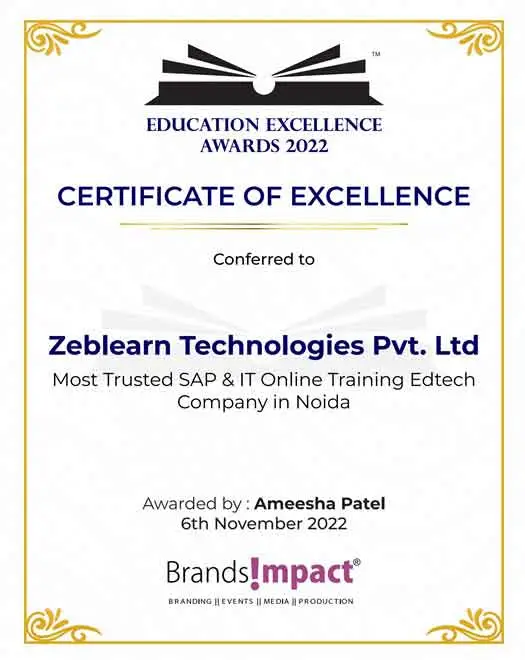
    •   Expert-Led Training
    •   Globally Recognized Certifications
    •   100% Job Placement Support
    •   Hands-On Learning
    •   Flexible Learning Options
    •   Affordable Course Fees
    •   Career Growth Opportunities
    best-seller-min

    () 60 Minutes WEBINAR with CERTIFICATE

    Date Time IST (GMT +5:30) Event Free Sign Up

    Explore Our Courses Across India - Flexible batches

    We are proud to offer our Machine Learning and AI Training Program services across numerous states nationwide.


    Call Us
    WhatsApp
    Questions? WhatsApp us.
    Placements query?

    We use cookies to improve your experience and personalize our site. cookie policy